
Morgan Thompson and Her Native Magical Girl
By, Savignon Swimmer
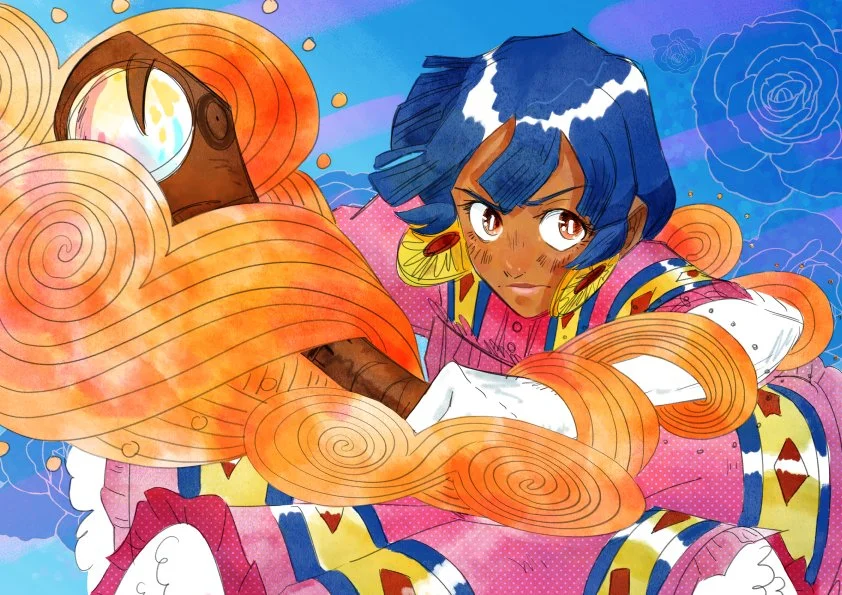
Photo shared by Morgan Thompson
In recent years, anime as a medium has become far more prevalent in pop culture and the public eye, so much so, that it’s gradually become less of a “niche” interest. However, I can still remember my surprise as I was scrolling through Instagram and came upon this drawing of an Indigenous girl, clad in a ribbon skirt with fire in her hand - a native magical girl. For those who don’t know, a “magical girl” is a type of character in an anime, who, typically through the powers of positivity and friendship, can transform into a different and, well, magical version of themselves to fight for the forces of good.
Seeing this drawing reminded me of others I’d seen, where natives artists had “Indigenized” anime characters they’d grown up with, or drawn their own versions of Indigenous magical girls. As an anime-fan myself, I had never imagined I’d get the chance to see these two worlds collide, and especially see so many people have their own unique takes on it. To learn more about these artists and the inspirations behind what they draw, I spoke to Morgan Thompson (Cherokee), an award-winning animator whose own Indigenous magical girl caught the attention of members across the community.
Morgan grew up all across Oklahoma, and remembers how she had never considered animation or art in general to be an actual career choice until later on in life. Of course, their interest in both those fields and filmmaking were still quite prevalent. “I was that weird kid that always liked to go on the bonus features of the DVD, my siblings would get so mad at me because that was all I would want to do, and I would also draw quite a bit…eventually things started to click and I realized that with my passion for drawing and me loving film in general…something in film would work well for me.”
Having then landed on pursuing animation, Morgan made the choice to enroll at Sheridan College in Canada. There, she was involved with the character animation program, which also led to an internship with Titmouse inc. It was during her third-year film project where Morgan and her group worked together on the short animation “The Fox and the Pigeon,” which went on to win several awards.
It was around four years ago that the idea for her native magical girl first popped into her head. Growing up, Morgan would get up early to watch anime with her cousins, serving as some of her initial inspiration. While she was in school, there weren’t many other Indigenous students around her, so she never got to explore ideas related to her culture in her school work. During her free time, though, Mogan would start to think on projects she would want to work on one day. “I started to think of this native girl who works at an Indian taco truck, but she’s also a magical girl, and that’s been snowballing little by little…trying to figure out how I wanted this character to look and what I wanted her to represent. I wanted a very ‘modern’ way of storytelling, like Inuyasha.”
Morgan still considers the project in its entirety to still very much be in development, and is hesitant to give too much away as they’re determined to do it right. “I don’t want to present something that hasn’t been thought out…So I’m very cautious with it, and I hope that by being so cautious with it that I can get a very honest story that a lot of people can relate to.” Aware of how some people might take and distort the story to their own ends, Morgan is taking their time to reflect and craft the narrative that she envisions.
Anyone who takes a look at their work, can easily see the passion and energy that she imbues into it. As someone who is familiar with these genres, the excitement of seeing an Indigenous character in a story like this is unreal. It’s representation I never dreamed could exist, and it’s reassuring to know that the next generations may very well grow up with these sorts of characters. When I was first made aware of Morgan’s work, I had never expected to see the blending of Indigenous culture and fandoms such as anime and manga, and it got me thinking why I was seeing so much of it now.
Morgan attributed this to: “Anime is just more attainable, cause when you look at western animation, we don’t ever really see ourselves, and there’s a lot of barriers that come with that…I remember Pokemon, Yugioh, Sailor Moon, those were the stuff you’d wake up early in the morning to watch…With me and my cousins, anime and manga were just more accessible…I remember that my cousins would get Shonen Jump delivered to them.”
Morgan envisions for the story to one day be told through a comic format, seeing it as the most honest way to tell her story, but can also see it being adapted into some other medium as a possibility further on. Either way, she continues her stellar work as an animator on other projects, and is excited for the future of Indigenous involvement in the entertainment industry, and what influences that anime will have on it.
“I remember being so alone at Sheridan and even now I feel alone, yes, but there’s more people coming in and I’m just excited to finally see other people who grew up in the same place that I did…I’ve also noticed now that, especially within my industry, there’s such a big embrace of it, because so many of those people who did like anime, who did like all these different things, they’re starting to become the majority. I feel like in the next few years, we’re going to see more unique stories, more anime-inspired shows, because what wasn’t the norm is now going to be the norm.”
To learn more about and follow Morgan’s work, you can check them out on Instagram and Twitter @Skadoodlin, as well as their website and LinkedIn.