
The Native Community Sharing Their Rage at ASU Labriola's Metal Concert.
By, Kianna Joe
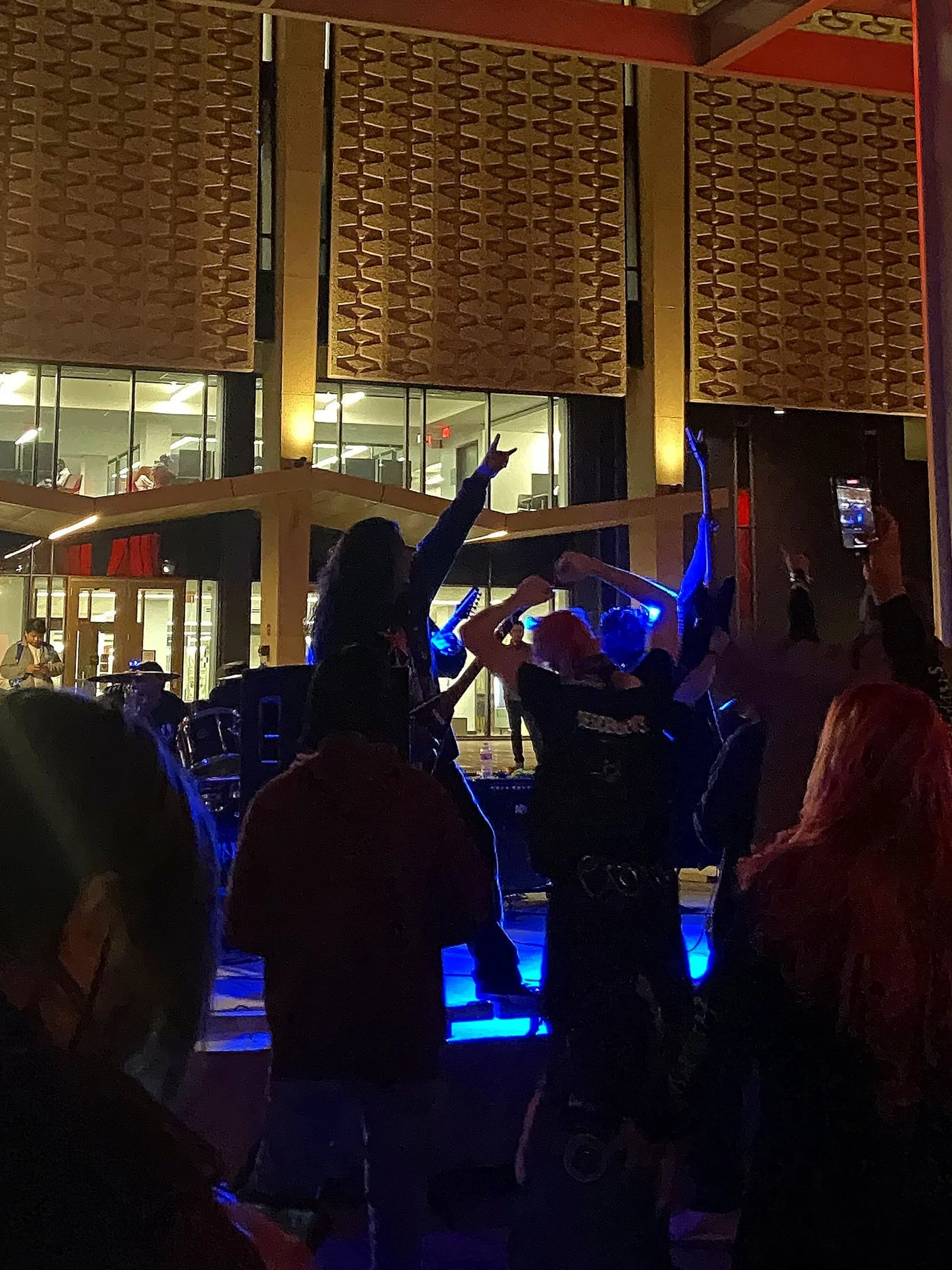
Photo Courtesy (Guardians AZ) ,
Kianna Joe
The spring semester for college students at Arizona State University has rolled in full force with
classwork, deadlines, and other added stressors. In what was a much-needed relief for some,
ASU’s Labriola Library, an Indigenous-focused library, and AISA graduate representatives
collaborated to host the first pop-up “Rez” metal show at ASU’s Hayden Library on the Tempe
Campus earlier this month.
Eric Hardy, the senior program coordinator for the Labriola National American Indian data
center, said, “Today what we’re doing is a pop-up Rez metal show to kind of showcase the
creativity within American Indian communities through something like heavy metal and rock.
Also in the conversation of colonization, this is a space where you can kind of channel that
energy, that raw energy of the impacts of colonization.” They decided to hold the show in the
heart of the campus where thousands of students pass through each day, gathering the heavy
metal Indigenous community to share their love and music and to release some of the stress from
school and life.
Up first was Sage Bond, a Navajo and San Carlos Apache singer/songwriter. Bond amazed the
audience song after song with a continuous range of vocals that energized the crowd into
headbanging. After her performance, Bond said “I really like their (Labriola Library)
introduction of taking up space, making a space for ourselves, otherwise that space wouldn’t be
made, we have to come in here and stand our ground.
As each band was introduced, war hoops resonated across the camps, “skoden” and “stoodis”
and other Rez slang terms creating an energy and sense of belonging.
Following that was “Guardians AZ”, a Tohono O’odham heavy metal Rez band central to Sells,
Arizona, who originally started their musical journey in 2014 out of Tucson, Arizona. Gabe
Mendoza first started the band with Jayare, and from there the pair reached out to other artists to
fill out the rest of the band. Today, its members consist of “Native Dave” (Bass), Anthony, A.J
(drums), Gabe (guitar), and Jayare (guitar and vocals).
Mendoza said, “These bands like us, they have these songs that have a voice. Like ‘Centuries of
Torment’ (written by Jayare) has a lot of the history of how it was way back then when
colonizers came and kinda r*ped our language, people, and that kind of thing.” Just moments
after their music broke the silence, headbangs turned into a mosh pit. Many took punches, jabs,
and a meetup with mother Earth but continued to jump back up, letting the music fuel their
movement.
Stepping up next was “Alliance”, a band formed in 2011 on the San Carlos Apache reservation.
For many native metal bands, their songs portray the emotions related to the continuous impacts
of genocide and discrimination in western society felt by native people. Isaiah Patterson, the lead
vocalist for the band, said: “We made this band to connect with people because we all go through
similar struggles, this event also brings all the different tribes together. Not even just them, even
from the town, they see us and say ‘oh there are Native Americans, they can also make music
like this’ and see us having a good time.”
Following that, Aaron Steel, the rhythm guitarist for the band, said: “I think more so, it will
broaden and expand more minds to see that Native Americans can do this kind of stuff.” The
frustrations echoed in the band’s music, drawing in the crowd and sending them into an emotion-
fueled frenzy, giving them a chance to vent.
Patterson added, “Even though it’s screaming and all that, people can feel the emotions, you’ll
feel it and the energy.
Last, but not least, was M.I.S., Merciless Indian Savages. The band’s composed of members
from all across Indian country, formed in 2019 and having released an album the following year.
The members consist of Corey Ashley from Sanders, Arizona (rhythm guitar), Jacob Stepetin
from Akutan, Alaska (guitar), Ruben from Hopi, Pima, and Yaqui communities (bass), and
Joseph Manuel from Sacaton Arizona (drums).
M.I.S. shared their excitement to be performing at the show, especially for a mixed crowd of
natives and non-natives. Ashley said, “It’s cool that other people see the nuances of our
community, they only see one side, one stereotypical thing, most people haven’t even
encountered a Native American in their life. We’re people too, we like metal too. Particularly in
the Indigenous communities, there’s just this connection to metal.”
A continuous message shared among each band was the need for recognition of Indigenous
people and bands in the heavy metal scene. Ashley stated that “There’s a lot of Indigenous metal,
it pops up more in our community than it does in other communities. It’s a big thing on the rez
and even here. It’s a niche that a lot of people don’t know about.”
Following that, Stepetin said, “When I was in college, I wish there were metal shows. I would’ve
been here right away, it’s cool to be on the other side of that, the students here that have come up
to us and said ‘we’re so happy that you’re here’, we’re feeling that energy that is cool.”
Stepetin and Ashley also shared their views on stereotypes of the metal scene as a whole, as well
as the Native community. Ashley said, “Metals still seen as scary and shit, I don’t get that, if you
grow up with it, you grow into it, you feel it. It’s something you just feel, you can’t describe it.
It’s not so bad and when you dissect it, the musicians have to be really talented to pull this shit
off, a lot of people don’t appreciate it…Like intergenerational trauma that comes out naturally,
metals the perfect canvas to release all that shit.”
It’s no secret that the heavy metal scene has been stereotyped and portrayed as “bad” music for
“bad” people. For the Indigenous community, it’s much more than music, it’s an expressive art
that’s sharing emotions and it’s connecting people across Indian country. Stepetin added, “I think
it’s a really unique and expressive art form that doesn’t get the respect it deserves.”
Labriola and the AISA graduate representatives created a space that comforted the Indigenous
audience and that shared a piece of our culture with the non-native attendees. Hardy, from
Labriola, ends with “We’re trying to keep spaces where it’s for Indigenous people, create safe
spaces, but also for us to be able to share our emotions as raw as they are because it’s a part of
our community and it’s a part of our healing.”